

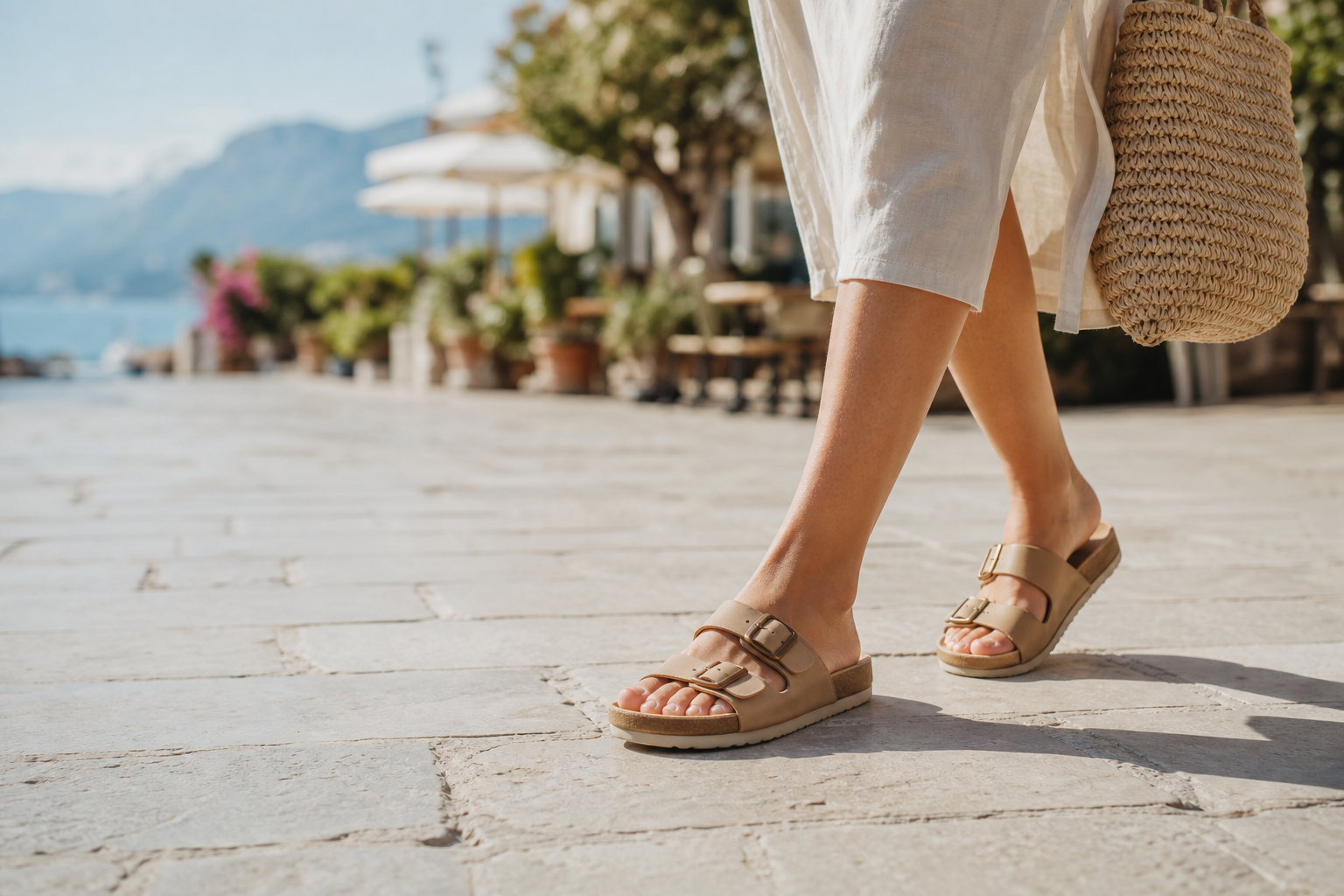
Summer trips often involve more walking than the itinerary suggests: airport corridors, hotel check-ins, waterfront paths, markets and an unplanned detour for dinner. The best sandals for that kind of day are not simply the softest pair in the closet. A useful travel sandal should fit securely, adjust as feet change through the day and match the surfaces you actually expect to walk on.
This guide explains how to evaluate adjustable comfort sandals without assuming that one style works for every foot. If you have persistent foot pain, numbness, swelling or a diagnosed condition, ask a qualified health professional for individual advice.
Start with secure fit, not the size printed on the box
Your heel should sit fully on the footbed, with a small margin behind it. Toes should not grip the sandal to keep it on, hang over the front edge or rub against a raised rim. Walk several laps indoors and notice whether your heel repeatedly lifts, the foot slides sideways or a strap presses one small area.
Try sandals later in the day when feet may be slightly fuller. Test both feet because they are not always identical. Use the store's current size chart and product measurements rather than assuming your usual sneaker size will translate exactly.
Why adjustable straps matter on travel days
Adjustable straps let you fine-tune the upper instead of relying on a fixed opening. The strap should hold the foot without leaving deep marks or forcing the buckle onto a sensitive area. After adjusting it, slide a finger beneath the strap: it should feel secure but not restrictive.
A two-strap design can distribute pressure across more than one point and may be easier to modify if your feet feel fuller after hours of walking. For an example of this construction, see the store's soft adjustable EVA slides with dual buckles. Review its current photos, materials, size options and care details on the product page before ordering.
Cushioning, support and flexibility are different things
Soft cushioning can feel pleasant at first step, but softness alone does not tell you how a sandal will feel after several kilometres. Press the footbed and bend the sole gently. A travel sandal usually needs some flexibility at the forefoot while remaining stable enough that it does not twist excessively during normal walking.
Terms such as “comfort,” “support” and “orthopedic” are used broadly in footwear marketing. Treat them as product descriptions, not medical guarantees. The meaningful test is how the shape, width, straps and sole work with your own feet and intended activity.
Match traction to the places you will visit
Look at the outsole pattern, not just the top view. Deeper texture may be useful on mixed outdoor surfaces, while a very smooth sole may be better suited to short indoor use. No sandal is slip-proof. Slow down on wet tile, polished stone, loose gravel and algae-covered paths, and choose activity-specific footwear for hiking or water sports.
| Feature | What to check | Why it matters |
|---|---|---|
| Adjustable straps | Secure without pinching | Allows small fit changes |
| Footbed length | Heel and toes stay inside | Reduces edge pressure |
| Forefoot flex | Bends where the foot bends | Supports a natural stride |
| Outsole texture | Appropriate for expected surfaces | Helps with practical traction |
| Weight | Comfortable to wear and pack | Useful for travel luggage |
Use a short break-in test before departure
- Wear the sandals indoors for 20 to 30 minutes.
- Check the toes, ball of foot, arch area and heel for rubbing or pressure.
- Adjust only one strap setting at a time, then walk again.
- Try a short outdoor errand on a clean, dry route if the return policy permits.
- Do not take a painful pair on a full sightseeing day and hope it improves.
Pack blister care and a second footwear option for longer trips. Alternating shoes can change pressure points and gives a damp pair time to dry.
Simple care after a hot walking day
Brush away grit that could abrade straps or footbeds. Follow the material-specific care instructions and let sandals air-dry away from intense direct heat. Do not place them in a dryer unless the manufacturer explicitly permits it, because heat can affect adhesives and foam.
Frequently asked questions
Should adjustable sandals feel tight at first?
They should feel secure, not painful. Persistent pinching, numbness, rubbing or deep strap marks are reasons to stop and reassess the size or style.
Are very soft sandals best for all-day walking?
Not automatically. Cushioning preference is personal, and stability, fit, flexibility and terrain also affect comfort over time.
Can I wear travel sandals on wet surfaces?
Only when the product is designed for that use, and with caution. Wet tile and smooth stone can be slippery even when an outsole has texture.
How much room should be around the toes?
Your toes should remain on the footbed during a normal stride without hanging over the front. Use the current size guide and test both feet.
The practical takeaway
Choose summer walking sandals by combining fit, adjustability, appropriate sole texture and a realistic break-in test. A good pair should stay on without toe gripping, avoid concentrated pressure and suit the surfaces on your itinerary. Review product specifications carefully, then test the pair before your longest day.